Duct Cleaning · Morpeth
From the Bridge Street restaurants to the care homes, venues and offices about the town, Morpeth runs on ductwork you never see - grease extract, dry ventilation and laundry runs where the dirt, and the fire risk, sit concealed above the ceiling.
Answer a few quick questions about your Morpeth canopy, filters and ducting for a guide price on stripping and degreasing the extract system - no measuring, no site visit.
Try the cost calculatorMorpeth trades either side of the Wansbeck with more ductwork than Bridge Street lets on. The restaurants, pubs and cafes along Bridge Street and Newgate Street push grease-laden air up through kitchen extract; the care homes, converted-chapel venues and offices about the town depend on dry supply and extract ventilation; and the hotels and launderettes run laundry ducting that packs with lint.
Behind a good share of those kitchens sits an extract system a canopy wipe never touches. Morpeth falls under Northumberland County Council, whose remit takes in 3,652 rated premises across the county - and grease ductwork is a fire matter as much as a hygiene one. Under the Regulatory Reform (Fire Safety) Order 2005 the responsible person has to keep it clean to a standard a certificate can show, whether the run climbs out of a Bridge Street kitchen or a Coopies Lane unit.
We clean and certify the whole system - grease, dry and laundry - across Morpeth and the wider Northumberland: from Bridge Street and Newgate Street to Carlisle Park and the Coopies Lane estate. We survey the full route, fit compliant access where a sealed run has none, and clean every internal metre back to bare metal.
TR19 Grease is the benchmark insurers and fire risk assessors expect for kitchen extract systems. It covers the whole system, measured, not just the parts you can see. Grease is assessed by thickness, and the standard sets the level at which a system must be cleaned and re-tested.
Across Morpeth we work to that one standard, whether the run climbs out of a busy restaurant kitchen or a care-home laundry.
Extract ductwork from fryers, grills and ranges coats itself in combustible grease along every hidden section to the roof fan. We clean the complete run to TR19 Grease and record post-clean readings.
Supply and general extract ductwork fills with dust, debris and mould that throttles airflow and spreads contamination. We clean and inspect dry ductwork so it actually ventilates.
Tumble-dryer and launderette ducting packs with lint, one of the most flammable build-ups in any building - common in hotels, inns and care homes, and easily overlooked until it is a fire.
Real jobs, described by sector and area - never by a client's name.
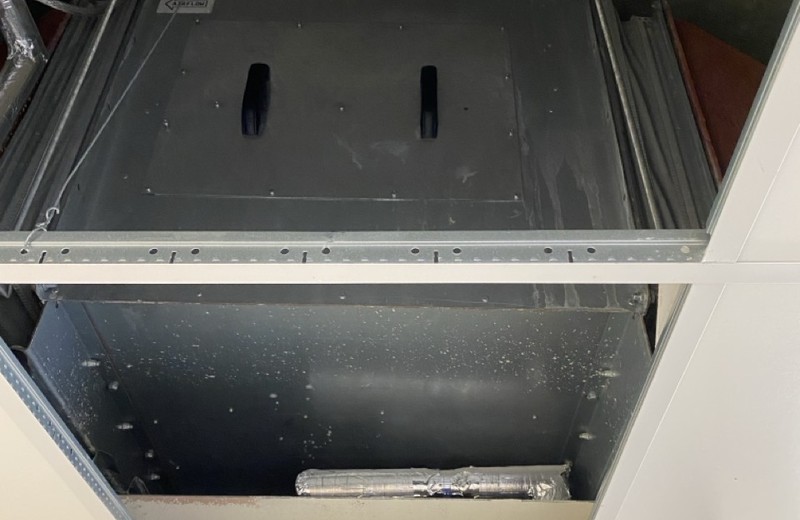
At a council-operated converted-chapel venue in Morpeth, the ventilation ductwork over the hall and its catering kitchen had silted with dust and lost draw, leaving the room close through a full event. We brushed and vacuumed the branch runs, cleared and reseated the diffusers, and renewed the tired panel filters, so the ventilation came back over the hall and the paperwork reflected the whole system.
At a restaurant on Bridge Street, the kitchen's grease extract climbed a concealed run to a roof fan with access on only the first length. We cut compliant hatches, cleaned the full run from canopy to fan back to bare metal, and logged grease-depth readings before and after. The system came back clean and certified, with a photo record for the fire file.
We trace the whole route, find where access is missing and set the scope and interval to your cooking hours.
Compliant hatches go in where the run is sealed, and the area is sheeted and protected.
The full run is cleaned to bare metal, with grease-depth readings taken as we go.
You receive the certificate, the readings, the photographs and a next-due date for the logbook.
The building. The Fire Safety Order puts the duty on the responsible person to control fire risk, and concealed grease is where a kitchen fire spreads fastest and least visibly.
The claim. Insurers expect a current certificate; a fire claim on a neglected system can be cut or refused - a costly surprise after a loss.
The day-to-day. A clean run pulls better, smells better and stands up when the environmental health officer visits.
Morpeth's Clock Tower has stood at the head of Bridge Street since the early 1600s, and its bells still ring the old eight-o'clock curfew over a town whose kitchens feed a steady Northumberland trade. The grease their extract carries banks unseen in the concealed run. We work around service so a Morpeth kitchen is cleaned, certified and back in action without losing covers.

Yes. We work throughout Morpeth and the wider Northumberland, including Bridge Street and Newgate Street to Carlisle Park and the Coopies Lane estate. Call 07961 915018 or use the contact form and we will confirm and quote.
The whole run - from the canopy through the concealed horizontal and vertical ductwork to the roof fan. The hidden sections are exactly where the grease and the fire risk sit.
We fit compliant access panels where the run is sealed or boxed in, so every internal section can be reached, cleaned, inspected and certified.
It depends on use. TR19 Grease sets kitchen extract frequency by daily cooking hours - roughly every three months for heavy use, six for moderate and twelve for light - and we set your interval and next-due date on the survey.
Yes. Dry supply and extract ductwork clogs with dust and can spread contamination, and laundry and dryer ducting packs with highly flammable lint. We clean and certify all three.
Yes. We work overnight, early mornings, weekends and closing days to keep your kitchen or site running.
We have cleaned and certified commercial ductwork since 2001, the length of the Northumberland coast and across the UK. Whatever the run - a grease riser, a dry office system or a care-home laundry duct - the work ends the same way: bare metal, a photo record and a certificate that stands up to a fire risk assessment.
Send us your site details and cooking hours and we will survey, quote and certify - across Northumberland.