
Extraction Cleaning · Ulverston
From the Market Street cooklines to the hotel kitchens, Ulverston cooks over open flame - and a greased-up canopy, filter and fan pull badly, run hot and add fire risk. We strip and degrease the whole system, canopy to fan, and certify it fire-safe.
Tell us about the canopy, filters and ducting in your Ulverston kitchen and get a guide price straight away - no measuring, no site visit, no waiting.
Try the cost calculatorUlverston cooks hard for a Furness market town. The restaurants and inns about Market Street and County Square, and the chain and country hotels about the town, all run extraction that faces the same test - a busy cookline, service after service, loading its canopy with grease. The settings vary; the grease does not.
Sitting inside a Westmorland and Furness food economy of 3,160 rated premises, an Ulverston cookline loads its canopy, filters and fan steadily. Once the grease sets, the hood stops capturing at the line, the kitchen turns hot and smoky, and the caked filters and fan sit as a fire risk over a live flame. We strip and degrease the whole system so the airflow - and the fire safety - come back.
Swapping filters treats the symptom; grease in the canopy, plenum and fan is what actually strangles the airflow. Clean the lot together and the cookline captures again, the kitchen runs cooler, and the fire risk over a live line comes down with it.
It is measured and evidenced to TR19 Grease, with the fan the tell: when a Ulverston kitchen goes hot and smoky, it is usually grease unbalancing the impeller, not the filters.
The standard on a commercial canopy. We strip, soak and scrape them back, and flag any that are warped or missing - the gap a warped filter leaves lets grease straight into the plenum.
Common on lighter lines and older canopies, and quick to clog solid. We clean what you run and advise where a baffle filter would serve a heavy frying line better.
On enclosed or recirculating systems. We service the stages, check the seals and tell you what needs replacing rather than cleaning.
Many cooklines carry a wet-chemical system built into the canopy. We degrease the filters, canopy and fan without disturbing the nozzles or detection - so you keep both defences.
Where a gas interlock ties the cookline to the extract, we work around it and leave it functioning, so the line cannot fire without the extraction running.
We check and clear accessible fire dampers in the run, so a damper that has to close in a fire is not seized solid with grease.
Real jobs, described by sector and area - never by a client's name.
At a chain hotel kitchen near Ulverston, plating restaurant and function trade, a heavy line had loaded the canopy and fan housing and the extraction had gone weak. We stripped and soaked the filters, scraped them and the accessible duct back, and degreased the plenum and fan. The extraction came back strong and fire-safe, with a certificate and before-and-after photographs for the file.
At an inn on Market Street the kitchen had gone hot and smoky mid-service - the tell that it is the fan, not the filters. Grease had unbalanced the impeller and it had stopped pulling. We cleaned the fan and the whole system together, so the airflow that came back was real and not just a fresh set of filters.
We check the canopy, filters and fan, gauge the grease loading and how far the pull has dropped, and agree the scope.
The cookline and any fire-suppression system are protected and the area sheeted before work starts.
Filters, canopy, plenum and fan are degreased end to end - twice over where the grease has baked on hard.
You get a dated certificate, before-and-after photographs and a recommended cleaning interval.

By cooking volume. A heavy line needs cleaning more often than a light one - TR19 Grease sets the interval by daily cooking hours, and we assess your grease loading and set a next-due date rather than guessing.
The whole system - filters, canopy, plenum, fan housing and impeller, and the accessible duct. Grease on the fan is usually what has actually killed the airflow, so filters alone rarely fix a hot, smoky kitchen.
No. We degrease around the nozzles and detection of a wet-chemical system without disturbing them, so both the extraction and the suppression are left working.
Yes - Market Street, County Square and the North Lonsdale Road estate, and across the wider Cumbria.
Yes. We work overnight, early mornings and closed days, at no extra charge for out-of-hours work, so the kitchen is ready for the next service.
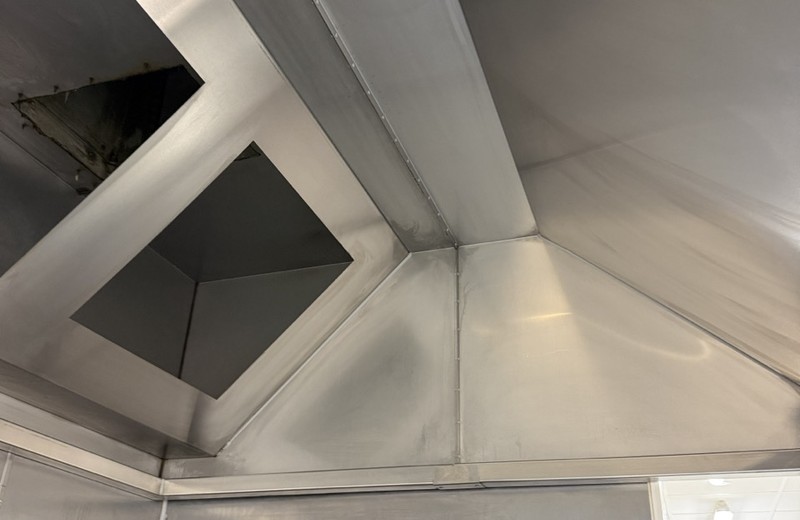
Ulverston keeps its markets on Market Street and in the Victorian market hall, Thursdays and Saturdays as it has for centuries under a charter of 1280, and the inns and cafes about them cook flat out for the crowd. That trade coats an Ulverston canopy and extract in grease service after service, and left in place the grease feeds flame and starves airflow. We work around service so the extraction is clean, certified and pulling properly before the next market day.
We have stripped, degreased and certified commercial extraction to TR19 Grease since 2001, across Cumbria and the UK. On a hard-frying line the job is the same every time: the whole system taken back, the fan balanced, and a certificate that satisfies your insurer and fire risk assessor.
Send us your cookline and frying hours and we will survey, strip, degrease and certify - across Cumbria.
